Hidden-object puzzles have entertained people for generations. They’re more than just a quick distraction — they help train your brain to notice patterns, sharpen concentration, and improve short-term memory. If you’ve ever enjoyed searching for hidden items in childhood puzzle books, you’ll love this visual challenge.
At first glance, the image below appears to show an ordinary bedroom. Everything looks perfectly normal — a lamp softly illuminating the space, a neatly arranged bed, and a few items placed on nearby furniture. Yet, somewhere within this cozy scene, four everyday objects are cleverly concealed: a book, an egg, a cup, and a pillow.
The 17-Second Challenge
If you’re confident in your observation skills, set a timer for 17 seconds and see how many objects you can identify before time runs out. This isn’t just a fun game — it’s also a simple test of your visual attention. According to cognitive psychologists, tasks like these activate both sides of the brain: the right hemisphere, which focuses on visual processing, and the left, which handles logic and categorization.You may notice that when you start searching, your eyes move in small, quick motions — called saccades. These micro-movements help your brain process details and distinguish objects that are partially hidden or camouflaged by similar colors and patterns.
Tips to Improve Your Focus While Searching
Finding hidden objects often comes down to a few helpful techniques:
Scan the edges and corners. Designers of visual puzzles often hide items near the borders of an image, where the eye naturally spends less time.
Look for outlines, not colors. When an object’s color blends into the background, its outline or shape often gives it away.
Pay attention to cluttered areas. Tables, nightstands, or bookshelves usually hold the biggest surprises because multiple textures and objects overlap.
Use pattern recognition. Our brains are wired to spot irregularities — anything that looks slightly “off” or doesn’t belong in the scene is worth a closer look.
Take short breaks. Looking at an image too long can make you overlook obvious details. A quick reset often helps the hidden object suddenly “pop out.”
6 Tips That Will Increase Your Focus and Concentration | Carreras Medical Center
How the Brain Handles Hidden-Object Puzzles
Visual puzzles like this one do more than entertain — they actually strengthen cognitive abilities.
Studies published in journals such as Perception and Frontiers in Psychology suggest that regularly engaging in search-and-find games can improve sustained attention and visual recall. This type of brain exercise may even support mental agility as people age.
Here’s why: when you search for specific items within a busy image, your brain must filter out irrelevant visual data — a process known as selective attention. It’s the same skill you use in everyday life when you’re looking for your s on a messy desk or trying to spot a friend in a crowded room.
So while this “book, egg, cup, and pillow” challenge feels lighthearted, it’s also quietly strengthening your focus and perception.
Common Hiding Spots in the Image
If you’re still struggling to find the objects, consider where they might be cleverly placed:
The book may be stacked with others of similar color or tucked beneath a lamp.
The egg could blend in with a round object nearby, such as a light fixture or decorative ball.
The cup might be behind a picture frame or shadowed area, partially hidden by the lamp’s base.
The pillow could be camouflaged against the bedding or headboard, designed to look like part of the furniture.
Keep your eyes moving, stay relaxed, and try not to focus too hard on one spot. Often, the moment you stop overthinking, the hidden items suddenly reveal themselves.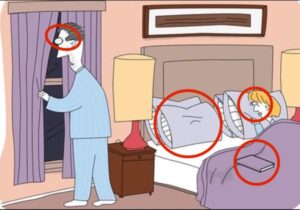
Why We Love Optical Challenges
There’s a reason online visual puzzles have become so popular. In today’s fast-moving digital world, taking a short break to solve a challenge can feel refreshing. It encourages mindfulness — a brief pause that brings your attention fully into the present moment.
In fact, according to the American Psychological Association, engaging in small problem-solving tasks can reduce stress and temporarily shift focus away from daily pressures. The satisfaction of finding something hidden provides a small dopamine boost — the brain’s “reward” chemical — which helps improve mood and motivation.
That explains why millions of people enjoy hidden-object games and brain teasers every day, whether in newspapers, apps, or social media challenges.
Did You Find Them All?
Once you’ve spotted all four hidden objects — the book, egg, cup, and pillow — take a moment to reflect on how your attention shifted throughout the search. Most people report that after finding the first object, the rest become easier to spot. This happens because your brain adjusts its search template, refining what details to focus on.
If you haven’t found all of them yet, don’t worry. You can always take another look after a short break. Sometimes stepping away from the image and returning later helps your eyes notice what you missed before.
9 Ways to Improve Focus and Concentration | Indeed.com
A Fun Way to Sharpen the Mind
Challenges like this remind us that keeping the brain active doesn’t always require complicated exercises. Something as simple as a hidden-object image can encourage focus, memory, and patience — qualities that are valuable in everyday life.
Try sharing this puzzle with your friends or family to see who can find all four items the fastest. Friendly competition adds another layer of enjoyment and helps strengthen social connection, another factor linked to cognitive health.
Key Takeaway
Hidden-object puzzles are more than just internet fun — they’re a playful way to train the mind and give your brain a mini-workout. Whether you find all the objects in 17 seconds or take a little longer, the real win is in staying curious and engaged.
So, can you spot the book, egg, cup, and pillow?
Take another look and test your powers of observation — you might surprise yourself.
Sources:
American Psychological Association – Attention and cognitive performance research
Frontiers in Psychology – Studies on selective attention and visual search
Perception Journal – Research on pattern recognition in complex images